
Sunday, July 8, 2012
Saturday, February 4, 2012
Ontologies of the Present: Dialectics and Genealogy from Hegel to Agamben
OSL Seminar directed by Bram Ieven en Geertjan de Vugt
When Foucault famously declared Sartre’s Critique of Dialectical Reason the last book of the 19th century the bell for the burial of Hegelian historicism was tolled. Foucault’s turn to Nietzsche and his revitalization of genealogy as critique can only be understood in opposition to the Hegelian dialectic. While the dialectic provides a method in which the singularity of thought is recuperated and placed within a larger ‘whole’ (Hegel) or process of unification (Sartre), genealogy shows us how the origin of certain modes of thinking and discourses are not recuperable within a bigger whole (Foucault) and are in fact shot through by a multiplicity that does not let itself become part of any straightforward process of unification (Deleuze).
However, both dialectics and genealogy are ways of coming to terms with the double bind one finds oneself inevitably confronted with when dealing with the idea that concepts, ideas and critical notions relate to the historical, political and social circumstances in which they are developed. On the one hand it implies that thinking is coached in its own, singular historical conditions, affected by them and shaped through them. On the other hand it implies that thinking itself also directly reflects on history and its own historicity. The idea that thinking should reflect on its own position, the idea that his is what thinking is about, is what the modern concept of critique is all about. The dialectic and genealogy, then, are two ways in which critique can be defined.
This seminar is based on three pillars. Firstly participants will familiarize themselves with the dialectic (Hegel, Kojève, Sartre), its criticism (Nietzsche, Deleuze, Bataille), and its persistence (Jameson, Malabou). Secondly we will study genealogy as a critical method by focusing on the work of Foucault and his interpretation of Nietzsche. The development of genealogy as a (alternative) form of critique, it turns out, was conceived of as a direct criticism of Hegel and the dialectical method. Finally we will go into one of todays most prevelant reinterpretations of Foucault, namely that of Agamben’s analysis of paradigms.
By the end of the seminar participants have a thorough understanding of the concepts vital for an understanding of (French) post-structuralist thought: dialectics and its relevance today, the stakes of a philosophy of difference, genealogical analysis and the archaeology of paradigms.
Each seminar session takes place on Friday from 2 to 5PM. For each session a special guest speaker will be invited who will be giving a one hour introduction to the theme after which we will do a close reading of the texts under scrutiny. Reading materials will be distributed in advance. Please register by sending an e-mail to: osl-fgw@uva.nl
More information and programme
More information and programme

Wednesday, September 14, 2011
Conclusion of Balibar's Utrecht lecture (September 14, 2011)
(...)
Europe is neither immune to the dangers of political and/or economic protectionism (i.e. nationalism, the closing of borders), nor to misguided attempts at regulation. It is not a given that Europe is able to mediate between extreme market liberalism and populism; we cannot simply rely on Europe’s supposed moral or political intelligence or common sense in this regard. The fact remains that the European borders are neither those of a state (if they were the issue of sovereignty would be more easily solved) nor are they the borders of just an economic market. The challenge of Europe lies in finding a form of institution that will successfully bypass the duality between these two concepts of borders; it will need to do this if it wants to open up new ways for political action on a European level, and thus for creating a new, collective Europe. We must let Europe subsist in order for it to invent new forms of action. This invention of new forms of action is what defines politics in relation to history.
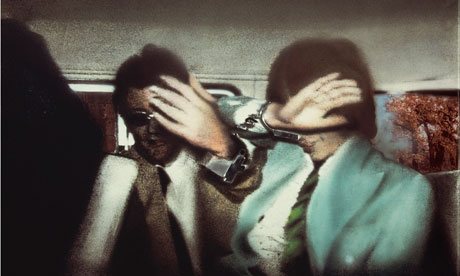
Richard Hamilton's Pop Politics (1922-2011)
Perhaps more than other pop artists, Hamilton was able to give his works a surprising political twist.
Saturday, September 3, 2011
Abstract Art Against Autonomy (Cheetham)
Cheetham’s Abstract Art Against Autonomy is a compelling if ultimately somewhat disappointing account of some trends in recent abstract art based on the premise that abstraction functions as a virus that infects other forms of art and ways of viewing. Instead of presenting the turn toward abstraction as the result of artistic discourse revolving around autonomy, Cheetham proposes a discourse on abstraction that argues in favor of the heteronymous, infectious effect of abstract art. This infectious dynamic of abstract art seems to be grounded in two arguments. A first argument is historical and goes back to Malevich, whose turn toward abstraction and theory of the additional element functions as the starting point for Cheetham’s book. He writes: ‘Because the additional element was explicitly modeled on the behavior of the tubercular bacillus, abstraction was construed by Malevich as a “disease” and put to work as both poison and cure in the Platonic and Derridean senses of the “pharmakon”.’ (8) The second argument has to do with the interaction between viewer and artwork and suggests that the artwork hs an infectious effect upon the viewer.
The use of infection as a concept that can open up our stagnated view on abstract art has certain potential, provided that the concept is able to move beyond the merely metaphorical. But more often than not Cheetham’s use of the words infectious and infection fails to have the conceptually enlightening function it aspires to. In many instances the ‘infectious’ qualities of abstraction are really not that clear and the use of this concept seems rather empty, if not ad hoc. One example: in criticizing Fried’s distinction between absorption and theatricality, Cheetham introduces the infectious as a third paradigm for engaging with a work of art. As opposed to the absorptive in Fried’s account, ‘in which the viewer and the work are held apart’, the infectious ‘model is indeed more literal in the sense that it acknowledges as a positive element the participation of the audience in the work.’ (46) One still wonders what the difference is, since the qualification that the viewer and the artwork are engage in a mutual relation that we could call infectious does not yet say anything about nature of that relation in certain historical periods (which was Fried’s aim in making a distinction between absorption and theatricality). Cheetham himself may have realized this too, since a few lines further down, when discussing Klein’s ‘sponge’ sculptures, he suggests that the infectious is not so much a separate category as it is a way of highlighting the literalness that comes with absorption: ‘[Klein’s] memorable sponge sculptures … were anthropomorphic bearers of “absorption” in a physical sense. The literalness of absorption was to be encouraged if art was to have a social force: theatricality of absorption defined the desired infection and transformation of the viewer through art.’ (45)
About Klein Cheetham argues: ‘Because Klein systematically took the monochrome beyond the frame of painting, our assessment of his legacy is a touchstone for how we construe abstraction since the 1960s.’ (56) This only makes sense if you accept the premise that the monochrome and the destruction of the frame are the two singular decisive breakthroughs in recent abstract painting. (The second premise is presumably influenced by Derrida’s account of painting and the frame.) But this just does not seem very convincing to me. At least not at first sight. It seems as if these premises, or at least the one about going beyond the frame, again indicate how much Cheetham’s definition of abstraction is overdetermined by the turn toward the conceptual in art.
As far as the premise on the monochrome is concerned, I am reminded of the following remark by Danto in After the End of Art: ‘Monochrome painting has its pleasure and victories, within the materialist aesthetic of the modernist narrative, but refining on the monochrome would correspond to a kind of wiping up operation in science, when, for example, one might fiddle with new data to get the orbit of the moon right.’ (141)
Wednesday, August 31, 2011
Previously unseen drawings by Lloyd Wright

Among the new drawings that came out of Frank Lloyd Wright's archive, this is probably my favorite.
Subscribe to:
Posts (Atom)